Nuremberg Trial Documents Signed by Göring, Hess, and Speer to Auction
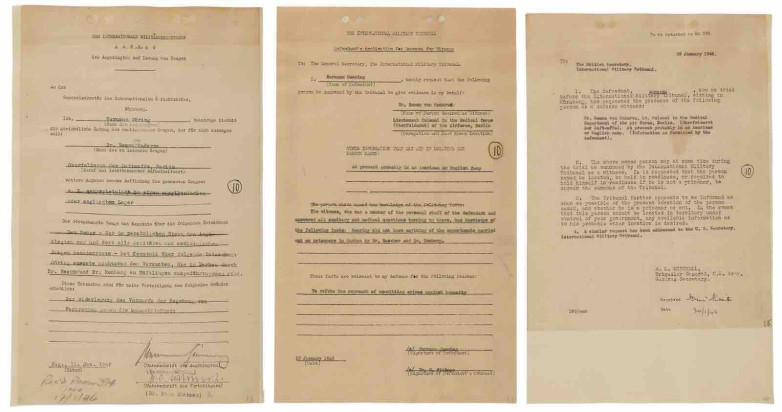
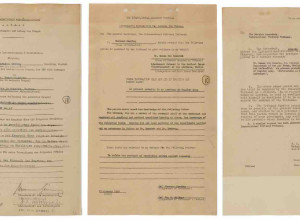
Hermann Göring denies knowledge of Dachau medical experiments on prisoners



Eighty years after the conclusion of the main Nuremberg trial, original documents signed by some of Nazi Germany's highest-ranking officials go under the hammer at RR Auction's World War II sale, closing November 19.
Nearly 130 lots of Nuremberg trial papers form the centerpiece of the auction, including witness applications, interrogation transcripts, handwritten letters, and signed statements by defendants who faced prosecution for war crimes and crimes against humanity. The documents record their attempts to challenge accusations, distance themselves from responsibility and prepare their defenses before the International Military Tribunal.
Among the highlights is a document signed by Hermann Göring on January 15, 1946, requesting testimony intended to establish that he had no knowledge of medical experiments conducted on prisoners at Dachau. The application states: "Goering did not know anything of the experiments carried out on prisoners in Dachau by Dr. Rascher and Dr. Romberg."
A letter signed by Rudolf Hess on January 23, 1946, addresses his intention to undertake his own defense following an accident involving his attorney. Hess, whose claimed amnesia had previously raised questions about his ability to stand trial, informed the tribunal's president that he intended to exercise his right to represent himself for the remainder of the proceedings.
Another document, a three-page interrogation transcript signed three times by Field Marshal Wilhelm Keitel, concerns orders involving the killing of downed Allied airmen. Dated September 27, 1946, just days before the tribunal's judgment, the transcript records Keitel's efforts to distance German military leadership from responsibility. "If an order was issued, then the responsibility for it lies with others, but not with us soldiers," he stated.
The collection also includes a 35-page handwritten declaration by Fritz Sauckel who oversaw Nazi Germany's forced labor program. Written shortly after his capture in 1945, before formal charges had been filed against him, the manuscript records Sauckel's denial of responsibility for wartime atrocities. "In no way am I a war criminal, just as many of my fellow comrades are not," he wrote.
A seven-page handwritten letter from Albert Speer to his attorney Dr. Hans Flächsner offers a different perspective on the preparation of a defense. Written during the early weeks of the Nuremberg trial, Speer discussed his reluctance to pursue the same kind of personal defense being developed by other defendants and addressed the question of responsibility for Germany's wartime actions.
The sale extends beyond Nuremberg to include material documenting military leadership and the events of World War II. Among the British highlights are Field Marshal Bernard Montgomery's top-secret battle orders for the liberation of Europe, his wartime personal messages to the Eighth Army and his double-badged beret, worn during the 1945 campaign in Germany.
Other offerings reach back to the years preceding the war, including artifacts recovered from the wreckage of the Hindenburg following its final flight in May 1937. The group includes a passenger ticket, an in-flight radiogram, a fire-damaged wine menu and a porcelain fragment.
Also featured is John F. Kennedy's hand-corrected manuscript for Why England Slept, along with a draft telegram from Benito Mussolini to Adolf Hitler following the failed July 20, 1944, assassination attempt and a photograph signed by three men associated with the Iwo Jima flag raisings.